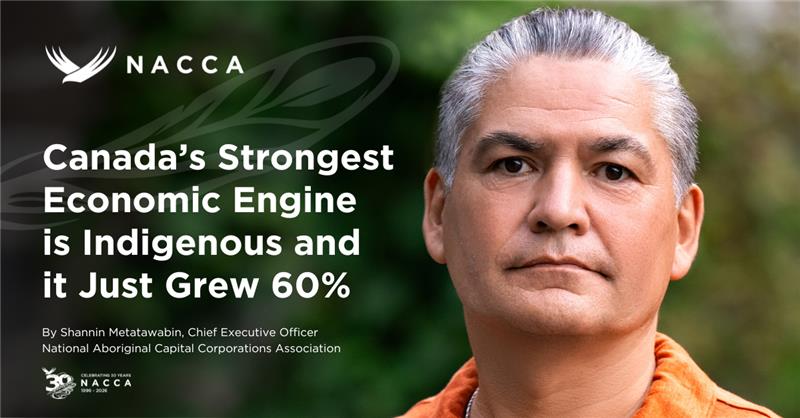
Canada’s Strongest Economic Engine is Indigenous and it Just Grew 60%
By Shannin Metatawabin, Chief Executive Officer, National Aboriginal Capital Corporations Association (NACCA)
Indigenous businesses are the growth story Canada keeps pretending not to see. They are scaling fast, running tight books, and already anchoring the supply chains the whole country relies on. These are not “up‑and‑comers”. They are the engine under Canada’s economy, and the only real question is whether we let them run at full power or keep riding the brakes.
Backed by the National Aboriginal Capital Corporations Association (NACCA) and 51 Indigenous Financial Institutions (IFIs), Indigenous entrepreneurs are quietly doing something the rest of the economy is struggling to pull off: real growth, in real communities, with real discipline. In 2022, this network lent 109.7 million dollars. By 2025, that had climbed to 176 million dollars. That’s a 60.1 percent jump in three years, driven by Indigenous people building businesses in places most commercial banks still treat as “too hard.”
Those dollars are turning into hundreds of millions in GDP for Canada every year. Indigenous entrepreneurs are paying workers, buying equipment, winning contracts, and keeping money circulating in the communities that resource projects and supply chains depend on.
NACCA is now 30 years old. Some of its IFIs have been doing this work for four decades. In that time, they have taken modest public investments and turned them into jobs, incomes, and community stability.
The opportunity for Canada is real and already performing. This is an engine of the economy.
Since the mid 1980s, the network has delivered 54,484 loans valued at more than 3.56 billion dollars. Today, NACCA supports the IFI network in their lending and management of a 425 million dollar loan portfolio. With programming and funding from NACCA and capital through the Indigenous Growth Fund (IGF), we’re supporting Indigenous entrepreneurs in every region of the country.
The economic impact is equally compelling. An independent analysis by the Conference Board of Canada found that IFI‑driven investments between 2016 and 2021 generated $876.6 million in GDP and $514.8 million in labour income from a total investment of $813.2 million. The same study concluded that every dollar lent by Indigenous Financial Institutions created approximately $3.60 in GDP, with more than $212 million in direct GDP impact coming from Indigenous‑led food production and food services alone.
Applying this model to NACCA’s most recent lending shows what that performance means today. Last year’s $176 million in lending is estimated to have supported more than $641 million in GDP and nearly $380 million in income for Indigenous workers and entrepreneurs. That growth is being delivered responsibly, with a repayment rate exceeding 95 percent, a 38.8 percent increase in businesses owned or co‑owned by Indigenous women, a significant rise in clients under the age of 35, and active lending in all ten provinces and three territories. This success outperforms most programs offered by Canada. Over 30 years, the impact adds 12.7 billion to GDP, adding 181 thousand steady jobs and labour income of more than 7.6 billion.
By any standard, this is strong financial performance, and it reflects a model built on trust, local knowledge, and accountability.
The social indicators across the NACCA IFI network are every bit as powerful as the lending numbers. Over the past decade, this Indigenous‑led system has helped more people access the health and mental health support they need, and has made food, housing, and income more secure for families. Together, these gains translate into tens of thousands of better outcomes for Indigenous people: more stable homes, steadier paycheques, and communities that feel less precarious and far more hopeful. This is what economic reconciliation looks like in action.
Why does this matter to Canada’s future? As governments invest more than 126 billion dollars in nation building infrastructure, from clean energy to transportation, the question isn’t whether Indigenous businesses are ready to participate; because they are and have been for a long time. The real question is whether Canada will make sure they’re included for the benefit of all Canadians.
With NACCA and the IFI network, the journey to prosperity already exists. This isn’t a pilot project or a policy experiment. It’s a mature, Indigenous designed financial ecosystem delivering measurable economic and social returns year after year.
These institutions provide capital, business support, and trusted local relationships in places where traditional lenders don’t typically operate. They’re not just financing businesses; they’re building stronger local economies and brighter futures for Indigenous communities and Canada.
From May 5th to 7th, thought leaders, government partners and stakeholders will gather at the 7th NACCA Indigenous Prosperity Forum in Gatineau, Quebec. Working together as the pathway to prosperity continues to grow.
As Canada looks ahead, the path is clear.
NACCA has the network. NACCA has the results. NACCA has the momentum. Canadian prosperity needs Indigenous prosperity. It’s the smart thing to do.